Introduction: The Beginning of the Age of Personal Computers
Just over 50 years ago, personal computers were bulbrent, expensive machines with lower processing capacity than a current smart watch. What seems absurd today was considered revolutionary.The 1970s marked the tipping point when companies like Apple, Commodore and IBM realized that there was a market for affordable machines relatively speaking 'for home and professional use.
At this time, having a computer at home was a status symbol.The technical limitations were so severe that virtually everything we do today on our smartphones would be impossible on those devices.Let's explore what it was like to work with these first computers and understand the reasons behind their so drastic restrictions.
The Apple II: The First Commercial Success
Launched in 1977, the Apple II was the first personal computer to achieve mass commercial success.With an initial price of US$1,298 (approximately US$6,500 in current values), it was a relatively affordable machine compared to professional computers of the time.
Its specifications were humble according to modern standards: MOS Technology 6502 processor with 1 MHz speed, only 4 KB of RAM in the basic configuration (expandable up to 48 KB), and black and white screen with maximum resolution of 280 × 192 pixels. For context, a modern smartphone has 200 times faster processor and hundreds of millions of times more RAM memory. The storage unit was a 5.25 inch floppy drive with a capacity of 140 KB (approximately the size of a photograph in current high quality.
The Apple II revolutionized the market precisely because it was the first to offer an intuitive experience with colored fonts and graphics that worked. Its competitors, such as the Commodore 64, had similar specifications, but the Apple II won the professional segment, especially after the launch of VisiCalc, the first spreadsheet.
IBM PC: The Standard that Dominated the Market
In 1981, IBM released the PC (Personal Computer) that would become the ancestor of all current Windows computers. Initially, the IBM PC offered 16 KB of RAM, Intel 8088 processor of 4.77 MHz and 5.25-inch floppy storage with 160 KB of capacity. It cost $4,290 in the basic configuration.
An absurd limitation of the original IBM PC was the absence of hard disk. All data and programs needed to be manually loaded from floppy disks, an extremely slow and error-prone process. Users needed to constantly exchange floppy disks during work, interrupting the fluidity of work. A 10 MB hard disk today a negligible fraction was considered a luxury that added US$ 3,000 to the price.
Despite the limitations, IBM PC became the industry standard because IBM allowed third-party manufacturers to produce compatible components.This generated an explosion of innovation and cost savings.Still, until the mid-1980s, most PCs had less than 1 MB of RAM, making multitasking virtually impossible.
Technical Limitations that Look Like Science Fiction
Insufficient RAM Memory
The first personal computers ran on a comparable amount of memory to what a document file occupies today. A typical 1980s word processor consumed 64 KB of RAM just to run. This means that with the default configuration of 128 KB, very little space remained for user data. Having 512 KB was considered fancy and virtually guaranteed that you would never run out of memory.
Storage Through Fragile Floppies
5.25-inch floppy disks were the main form of storage until the mid-1990s. With a capacity of 360 KB to 1.2 MB (depending on density), a single 500-page document occupied multiple floppy disks.They were extremely fragile: a magnet, improper temperature or physical contact irreversibly damaged data.Many users lived with the terror of losing work of hours or days by a faulty floppy disk.
Access times were also miserable.To read a file, the drive took several seconds just to locate the data on the disk.
Glacially Slow Processors
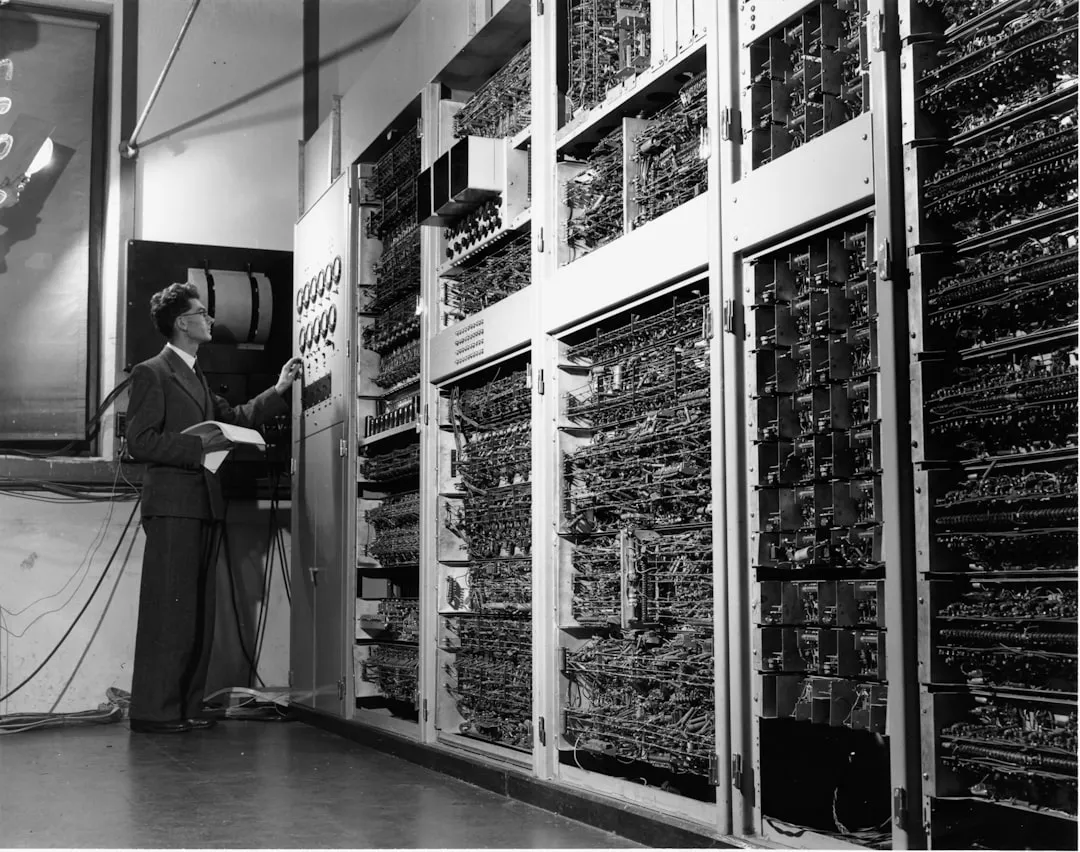
An original 1993 Pentium (90 MHz) was considered too fast for most users' needs. Even so, it took minutes to compile simple programs or process basic images. 3D graphics were virtually impossible; when they began to appear, they generated about 5-10 frames per second at minimum resolution.
Primitive and Tiring Displays
CRT (cathode ray tube) monitors from the 1980s and 1990s displayed resolutions ranging from 320 × 200 to 640 × 480 pixels. Colors?Most had only 16 colors available. This meant designers had to be creative to the extreme to create readable interfaces. Eye fatigue was common; working 8 hours on a low-resolution CRT monitor caused intense headache.
Software Compatible with These Brutal Limitations
The MS-DOS, which dominated the market from 1985 until the early 1990s, was a command-line operating system that consumed only a few kilobytes.There was no graphical interface; everything was done by typing arcane textual commands. A user needed to memorize dozens of complex commands just to perform basic tasks.
The first programs were equally primitive. Text editors like WordStar occupied 48 KB and offered basic functionality. Spreadsheets like Lotus 1-2-3 were extraordinarily complex for handling data, because even doing simple calculations required significant processing. Games were two-dimensional representations with pixelated sprites.
The Exponential Evolution that Changed Everything
The transition from the first PCs to modern computers was not linear.Every 18 months, approximately, the processing capacity doubled (Moore's Law). This means that the technology advanced at exponential speed, not arithmetic.A computer launched in 2000 was hundreds of times more powerful than one in 1990, which in turn was hundreds of times faster than one in 1980.
The adoption of hard disk as standard in the late 1980s was transformative. Suddenly, users could store hundreds of megabytes of data without loading stacks of floppy disks.Windows 3.0, released in 1990, brought accessible graphical interface that finally freed users from the need to know command line commands.The internet, which emerged commercially in the mid-1990s, required even more powerful computers, creating incentives for continuous innovation.
Today, computing power that looked like science fiction in 1990 is ancillary.A $300 smartphone has more processing power than a university supercomputer in 1980. RAM that cost $1,000 per megabyte is offered in cents. Storage that was measured in megabytes is now measured in terabytes.
Conclusion: Appreciating Current Technology
Understanding the absurd limitations of the first personal computers offers valuable perspective on the technological miracle that is using a modern computer.What seemed futuristic in 1980 (instant communication, access to unlimited information, creative work with multimedia is now trivial.
The frustrations that early users experienced: waiting minutes for a simple operation, losing work to faulty floppy disks, dealing with cryptic interface 'DOI shaped the direction of technological innovation.Each limitation was a barrier that engineers solved, each frustration a problem that created incentive for a better solution.
The next time your computer performs a task in milliseconds, remember: 40 years ago, this would have taken hours.The technology is genuinely extraordinary when compared to what we had not long ago.